

◆
Traced back to cartilage. AED was identified inside a polypeptide complex derived from animal cartilage, which is where its joint-tissue research focus begins.
Dose ranges reflect commonly studied amounts in published research models. This is not medical advice. For research use only. Not for human consumption.
Protocol Comparison
Recovery
Research dose range
Standard research range
3 - 4 mg
Core daily range of community cartilage courses, typically run for several weeks at a time.
Research focus
Cartilage / ECM / cellular aging
Observed window
Multi-week courses
Administration
Once daily (community-reported)
Primary pathway
IGF1 / NFκB / gene expression
Tier ranges reflect community-reported protocols, not a controlled dose-finding study; no human injectable dose for Cartalax has been established in the literature. Cell-culture findings summarized in Linkova et al., Int J Mol Sci, 2023. For research use only.
PROTOCOL BENEFITS
◆
Traced back to cartilage. AED was identified inside a polypeptide complex derived from animal cartilage, which is where its joint-tissue research focus begins.
◆
In aging human stem cell models, AED raised expression of IGF1, a growth factor tied to tissue-building activity.
◆
In aging fibroblast models, it was reported to influence markers of proliferation, apoptosis, and MMP-9, an enzyme that breaks down extracellular matrix.
SCIENCE
Cartalax is the synthetic form of AED, a tripeptide built from just three amino acids: alanine, glutamic acid and aspartic acid. It comes from Vladimir Khavinson's bioregulator research school in St. Petersburg, which works from one bold idea: very short peptides may help tune gene expression in the tissue they come from. AED itself traces back to a polypeptide complex extracted from cartilage.
The evidence is early and almost entirely cell-based. Studies report AED raising IGF1 and NFκB expression in aging human mesenchymal stem cells, and shifting proliferation and apoptosis markers in aging fibroblasts. Most of this work comes from the group that developed the peptide, and no controlled human trial of injectable Cartalax has been published.
WHAT TO EXPECT
This is a slow compound, not a quick one. Bioregulator protocols typically run in multi-week courses, and cartilage renews itself very slowly, so structural change in research models is measured in months, not days.
PROTOCOL NOTE
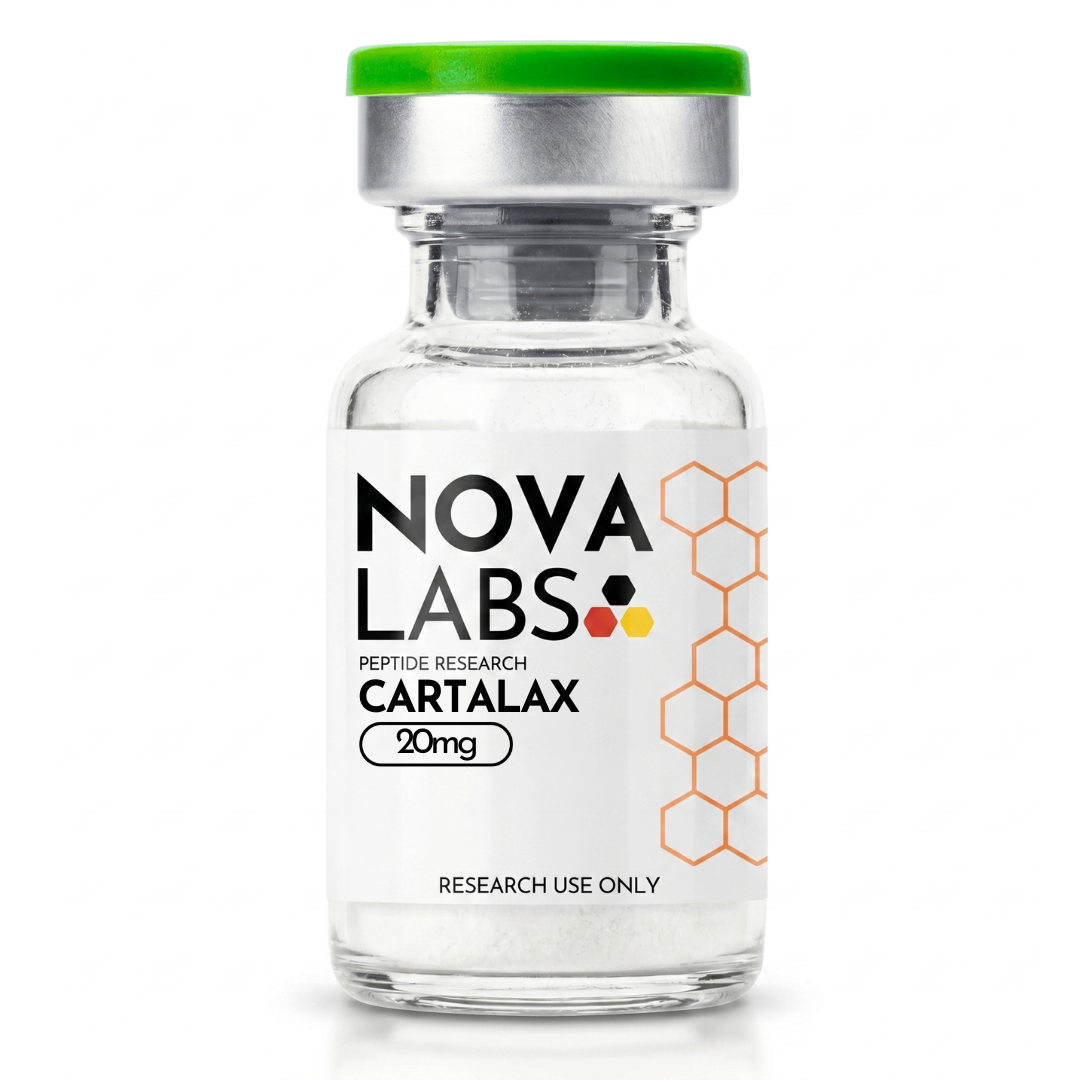
Available in 20mg. For research use only. Full documentation included with every order.
FAQ
The term comes from Khavinson's research school, which proposes that short peptides of two to four amino acids can enter cells and influence gene expression in a tissue-specific way. It's a working theory backed by cell data, not a fully established mechanism.
Mostly cell-culture data: changes in IGF1, NFκB, and proliferation and apoptosis markers in aging stem cells and fibroblasts. Animal data is limited, and there's no published controlled human trial of injectable Cartalax yet.
RELATED PRODUCTS