

◆
Sits at the very top of the reproductive hormone chain, activating the KISS1 receptor on GnRH neurons that set LH and FSH release in motion.
Dose ranges reflect commonly studied amounts in published research models. This is not medical advice. For research use only. Not for human consumption.
Protocol Comparison
Longevity
Research dose range
Standard research range
100 - 150 mcg
Core of the 100–200mcg community range, used to probe LH pulse stimulation and HPG axis signaling.
Research focus
HPG axis / LH / testosterone
Observed window
LH rise within ~30 min (IV)
Administration
2–3× weekly (community-reported)
Primary pathway
KISS1R / GnRH / LH–FSH
Tier ranges compiled from community-reported protocols (100–200mcg SC, 2–3× weekly) and cross-referenced with IV human studies; no subcutaneous bolus dose has been established in trials. Human data: George et al., J Clin Endocrinol Metab, 2011; Yeung et al., Eur J Endocrinol, 2026. For research use only.
PROTOCOL BENEFITS
◆
Sits at the very top of the reproductive hormone chain, activating the KISS1 receptor on GnRH neurons that set LH and FSH release in motion.
◆
In healthy men, a single IV dose raised LH within 30 minutes, and longer infusions increased both LH pulse frequency and testosterone.
◆
Pulsed beats constant: in a 2026 trial, intermittent dosing kept LH elevated for 12 days, while continuous exposure saw the effect fade within 5.
SCIENCE
Kisspeptin is the signal the brain uses to start the reproductive hormone cascade. It switches on GnRH neurons in the hypothalamus, which then tell the pituitary to release LH and FSH, the hormones that drive testosterone and estrogen production. Kisspeptin-10 is the shortest fully active form: the last 10 amino acids of the larger kisspeptin-54, carrying the exact piece that binds the receptor.
Unlike most research peptides, kisspeptin-10 has controlled human data. IV studies in healthy men showed fast, dose-dependent LH rises that peaked at 1 µg/kg, with a higher dose producing a smaller response. A 2026 trial found 12 days of intermittent subcutaneous dosing kept LH elevated. Its plasma half-life is only about four minutes, and responses in women vary with menstrual cycle phase.
WHAT TO EXPECT
Kisspeptin-10 acts fast and clears fast. In IV studies, LH rose within 30 minutes. In this compound, timing matters more than amount: the research points to pulsed exposure, since constant exposure dulled the LH response within days.
PROTOCOL NOTE
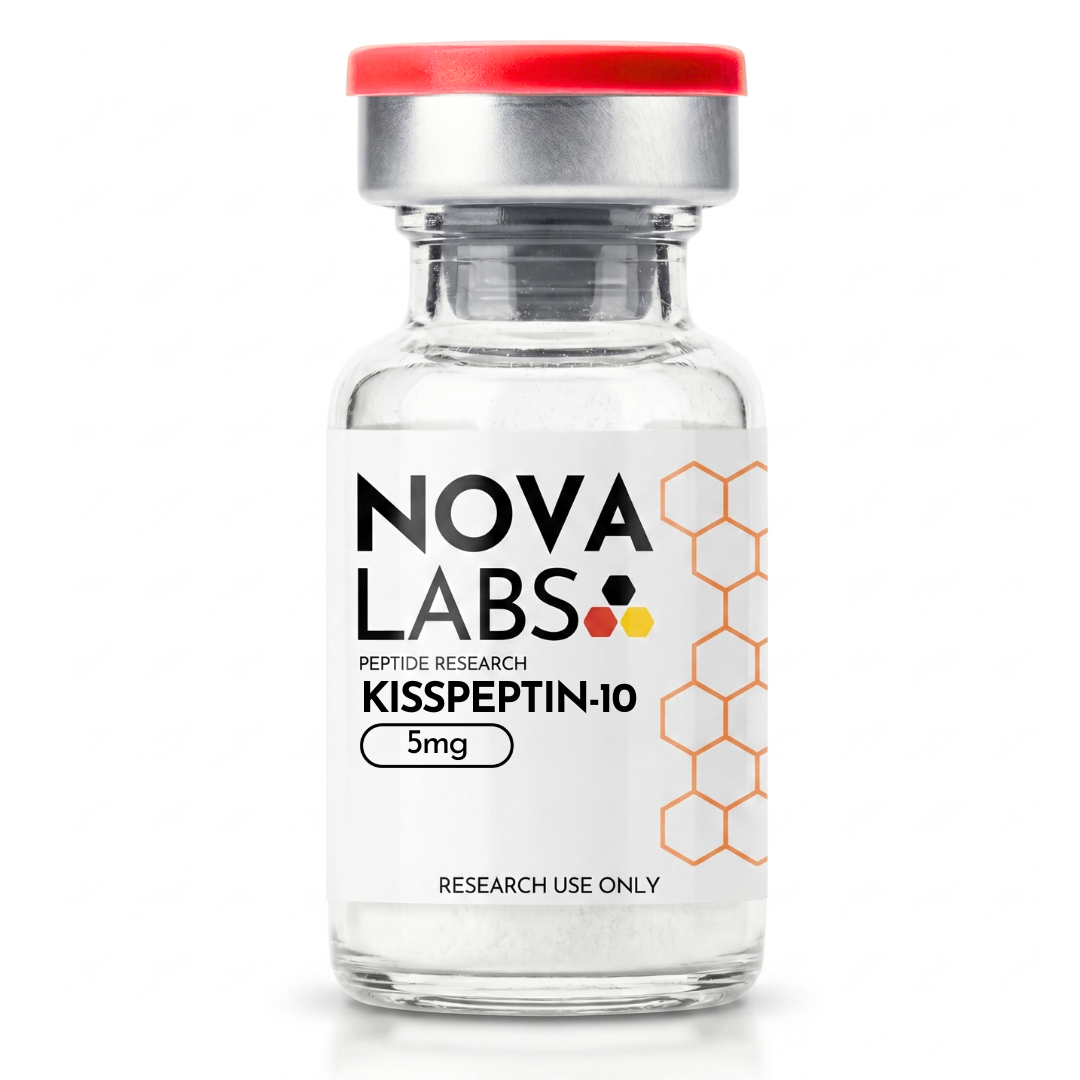
Available in 5mg. For research use only. Full documentation included with every order.
FAQ
The reproductive axis runs on pulses. A 2026 study found intermittent dosing kept LH elevated over 12 days, while continuous infusion lost its LH effect by day 5. That's why protocols are built around on-and-off exposure.
Kisspeptin-10 is the last 10 amino acids of kisspeptin-54, the part that binds the receptor. It's far shorter-lived, with a half-life of about four minutes, while kisspeptin-54 stays in circulation longer and has been studied in IVF research.