

◆
Directly stimulates dermal papilla cells (DPC) at the base of hair follicles.
Dose ranges reflect commonly studied amounts in published research models. This is not medical advice. For research use only. Not for human consumption.
Protocol Comparison
Skin & Hair
Research dose range
Standard research range
1 - 2 mg
Core experimental range for sustained follicle stimulation and VEGF expression.
Research focus
Hair follicle dermal papilla stimulation & microcirculation
Observed window
4-8 week active cycle
Administration
Daily laboratory topical or localized protocol
Primary pathway
Dermal Papilla Cells (DPC) / VEGF / TGF-beta1 suppression
Dosing compiled from copper peptide biological literature. For laboratory research and development only.
PROTOCOL BENEFITS
◆
Directly stimulates dermal papilla cells (DPC) at the base of hair follicles.
◆
Upregulates VEGF to support capillary microcirculation while suppressing follicle-inhibiting TGF-beta1.
◆
Engineered by exchanging a single amino acid from GHK-Cu, directing activity specifically to hair follicles.
SCIENCE
AHK-Cu is a copper tripeptide (alanyl-L-histidyl-L-lysine:copper) differing from GHK-Cu by a single amino acid residue. This subtle structural alteration specifically targets the biological microenvironment of hair follicles.
Ex-vivo research at Seoul National University demonstrated that AHK-Cu stimulates dermal papilla fibroblast elongation, boosts VEGF production, suppresses apoptosis-promoting TGF-beta1, and reduces programmed cell death markers by up to 78%.
WHAT TO EXPECT
Because the active anagen growth phase of hair follicles spans years, follicle cycling research is evaluated across active 4–8 week cycles followed by structured resting phases.
PROTOCOL NOTE
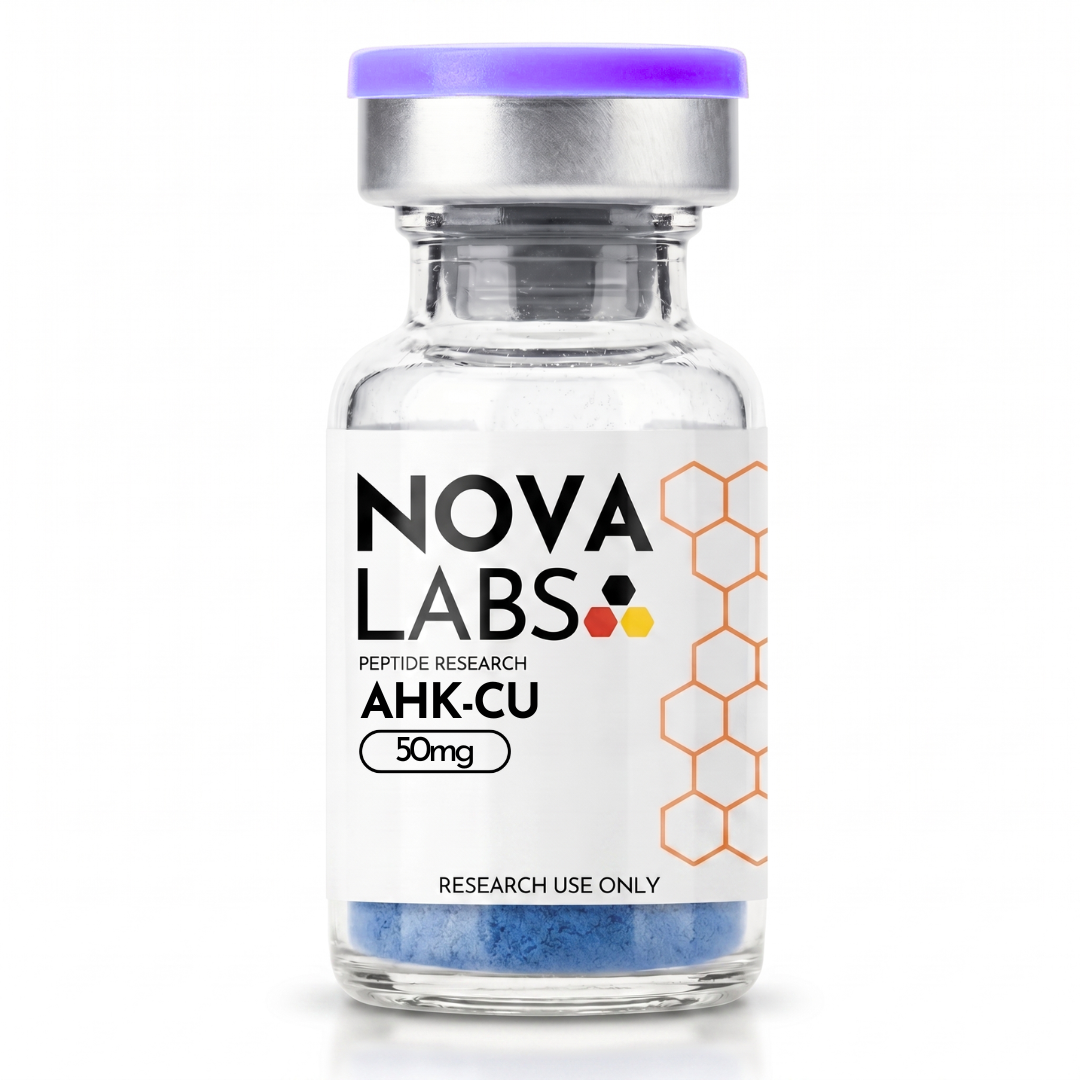
Available in 50 mg and 100 mg vials. For laboratory research use only.
FAQ
A single amino acid substitution (alanine replacing glycine) shifts AHK-Cu's binding affinity toward hair follicle dermal papilla cells rather than broad systemic collagen synthesis.
Because dedicated human clinical pharmacokinetic data for injectable AHK-Cu is limited, dosing models in research communities are extrapolated from its closest structural analog, GHK-Cu.